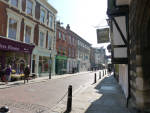
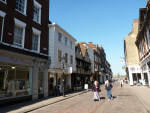
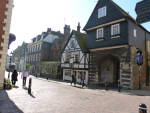
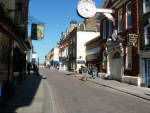
Rochester, unlike its namesake in Northumbria, goes all the way back to 8th Century Hrofaescaestir, which probably indicated a Roman fort called Hrofi. Hrofi itself goes back to an ancient Celtic name Durobrivis, which means a walled town with bridges.
An ancient British stronghold seems to have occupied the site of Rochester. A Roman fort succeeded, and took the name of Durobrivae or Durobrivis, from the Celtic words 'dwr' and 'briva', the former signifying 'water', the latter indicating a 'ferry'. A Saxon chieftain called Hrof, afterwards settled at it, and was known by the Saxons as Hrofeceastre, signifying 'Hrof's castle'.
Aethelberht walled it in 600AD, and founded a missionary church, which became the nucleus of the cathedral. Ethelred plundered it in 676. The Danes attacked it in 839 and 885; and were driven off, in the latter year, by Alfred the Great. Etheldred besieged it in 986. The Danes sacked it in 998. William the Conqueror built a new castle on the site of the Saxon and Roman fort, and gave it to Bishop Odo. William Rufus besieged and took the castle in 1088. Henry I, attended the dedication of the new or re-constructed cathedral in 1130. Much of the cathedral was destroyed by fire in the same year, and again in 1137. King John took the castle from the barons in 1215; and Prince Louis, took it in the following year. A tournament was held at the city, in the presence of Henry III., in 1251. Simon de Montford took the city, and besieged the castle, in 1264. Wat Tyler, in his insurrection, attacked the castle; and Edward IV repaired it. Henry VIII and Charles visited the city in 1522. Two Protestant martyrs were burnt in it in 1556. Elizabeth visited it in 1573; and Charles II, at the Restoration. The plague ravaged it in 1665. James II embarked at it, in his flight, in 1688. Christian VII slept at it in 1768. Queen Victoria went repeatedly through it in 1856.
Being the second oldest cathedral foundation in England, Rochester Cathedrals history goes back to 604AD when Augustine sent Bishop Justus to establish the house founded by King Ethelbert of Kent. Following several invasions by the Danes, the church was in a state of devastation by the time Bishop Gundulf was consecrated in 1077 but immediately he began a major building operation, and introduced a community of Benedictine monks in 1080.
The church suffered misfortune again in the mid-12th century with two serious fires, resulting in a further rebuilding programme. Since that time there has been continuous remodelling, refurbishments and restorations, mainly due to other historical events when the cathedral sustained damage. As a consequence of its very chequered history, Rochester Cathedral displays the varied building styles of each period, from the functional austerity of Gundulf's original structure, through the Romanesque, Gothic and Early English architectural periods, and continuing with renovation and restoration well into the 20th century following war damage....more
Rochester Castle stands on the east bank of the River Medway, to protect both the river and the crossing. It is one of the best-preserved castles of its kind in the UK. There has been a fortification on this site since Roman times circa. 43AD, though it is the keep of 1127 and the Norman castle which can be seen today. With the invention of gunpowder, other types of defence became more appropriate, and the military centre of the Medway Towns moved to Chatham.....more
For a city of its size, Rochester has had a fairly complex railway history, more so as a result of various uses of its name. The first company to purport to serve the location was the 1844-formed Gravesend & Rochester Railway, which began running train services between Denton and Strood on 10th February 1845. It never reached Rochester, the South Eastern Railway taking the reins at the end of the year as part of its North Kent Line building programme. In fact, Rochester did not receive any rails until the East Kent Railway extended their 1858 opened line from Chatham, over the Medway in March of that year, to connect with the track of the SER and run into that company's Strood station. Despite this, still no station was provided exclusively for the historic city, but the London Chatham & Dover Railway initially compromised: when the company commenced through running to Victoria on 3rd December 1860, a station on the northern bank of the river was opened asStrood. This was then renamed the following year to Rochester Bridge, presumably to provide differentiation from the older SER establishment (for the record, the somewhat remote LC&DR station was closed for good on 1st January 1917). It would actually be the SER which would open the city�s first two stations, but the second of these would instead bear the name of its neighbour, Chatham. The SER had attempted to negotiate running rights over the LC&DR's track from Strood to give the company access to Chatham. However, a non-cooperative LC&DR resulted in the SER planning its own route to the naval town. For this, a lattice girder double-track bridge was built parallel with the existing LC&DR structure over the Medway, and on the southern bank of the river 20th July 1891, the SER opened Rochester Common, the city now had its first proper station.