Queenborough literally means 'a queens' borough' named after Queen Philippa.
King Edward III, ordered that a fortress be built at Sheppey and be called Queenborough Castle. It was built to guard the passage of ships along The Swale, during the Hundred Years' War with France. It was built on the site of a much earlier, but smaller castle. This later fortress was a round symmetrical one with 70 rooms, modelled on French-style chateaux of the period; it regained importance in the 16th century under Thomas Cheney, when it is thought to have influenced the construction of nearby Deal Castle and Walmer Castle.
King Edward III had the town renamed after his Queen, Philippa of Hainault, and conferred upon it the rights of a free borough, with a governing body of a mayor and two bailiffs. He granted Queenborough a charter in 1366 and two years later bestowed the duties of a royal borough upon it.
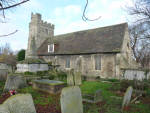
When Edward III commanded that a castle should be built upon the Isle of Sheppey he also ordered that the supporting town of Queenborough should be built adjacent to the new fortress. The construction of the castle, commenced in 1361, was well advanced by 1365 when attention was turned to the building of the accompanying town, a broad High Street being laid out westwards from the main gate of the castle towards the banks of the nearby Swale. It was on the northern side of this High Street, at a point near its mid-length, that a large plot of land was allocated to be the site for the town's church.
Initially dedicated to St James, by the mid-fifteenth century the church had received a re-dedication, becoming the Church of Holy Trinity. Possibly the change was necessitated because of confusion arising with the other Sheppey church of St James at Warden. Because Queenborough had been built on land laying within the parish of Minster the church was deemed to be a chapelry of Minster Abbey. When the Abbey was closed in the Dissolution of 1536 Queenborough was disappointed to find itself still obliged to pay tithes to the parish church at Minster, which continued to retain a tight control over the religious affairs of its Queenborough parishioners. A Visitation of Archdeacon Nicholas Harpsfield in 1557 revealed that the church had no font, 'for as they say, they never marry, bury nor christen but at Minster'.
The subservience of the church to Minster remained for many years a source of discontent at Queenborough. In 1583 there was hope that the issue might be resolved when, on 28th June, John Cobham, one of the town's Members of Parliament, wrote to the Mayor that he had 'spoken to my Lord of Canterberrys grace, and he is contented to make oure town a parrych'. Unfortunately a week later Archbishop Grindal died and, his successor seemingly being less well disposed towards changes being made at Queenborough, the church remained firmly tied to Minster. In 1607 the Mayor and Jurats decided to make a direct petition to the King pointing out that, although Edward Ill had built them the chapel, and they provided their own curate, they were still required to pay tithes to the parish church at Minster. The appeal produced a favorable response and, within a short period of time, Queenborough found itself for the first time detached from Minster as an independent parish.
Now at last the townspeople were able to have christening, marriage and funeral services in their own church, and use their churchyard for burials. For the christening ceremonies Nicholas Taylar, one of the Jurats of the town, stepped in to present the church with its first font. The font, installed in 1610, was of an attractive octagonal design, manufactured from Kentish ragstone with a domed oak cover. Its most interesting feature, however, was the stylised representation on one of its faces of the Keep of Queenborough Castle. The castle itself, was fated to be destroyed in 1650 when Parliament, having declared the fortress obsolete, ordered its demolition, the stonework being shipped off to London by the boatload for use in paving the streets about Whitehall.
The most pressing problem to be faced by the newly constituted parish of Queenborough was the distressed condition of its church tower. Various ineffectual attempts were made to patch up the fabric, but it was obvious that a far more radical solution would be necessary if the tower were to be saved. A major rebuilding was regarded as the most satisfactory remedy, but such a course of action lay well beyond the financial means of the town, and it was decided to petition the King for a fund-raising brief. The brief - a printed appeal sponsored by the King and issued to every parish in the land asking for donations - was issued on 7th April 1636. In it the recipient parishes were informed:
That the Steeple of the Church of Queenborow aforesaid standing open to the sea, and being a common Land marke at Sea, to which place Mariners and Seafaring men in time of foule weather or danger make for Shelter, Which said Steeple is now by the extraordinarie violence of Tempest become so Ruinous and in such decay, that it is very likely to fall to the ground, The fall whereof will be very dangerous and hurtful to the body of the Church. Upon the repairing and beautifying whereof the said Inhabitants have of late expended and disbursed a good summe of money, but are no wise able to new build the said Steeple: Which being viewed by well experienced workmen, must of necessity with part of the Church be taken downe to the very foundation, The charge whereof as the said workmen doth affirme, will Amount to the Summe of Six Hundred Pounds at the least, which charge the said Inhabitants are no wayes able of themselues to undergo, the whole Towne and liberty thereof consisting but of Two Hundred Acres of land, with Two & Thirty Housholds, and the most part of them very poore Fishermen.
The result of the appeal proved to be a disappointment, only a quarter of the necessary money being raised and, instead of a rebuilding of the tower, a major refurbishment had to be settled for, sturdy stone buttresses being added to make the structure more secure.
During the reign of Charles II the establishment and growth of a large naval and military community at nearby Sheerness brought Queenborough into an association with many leading government officials of the day. To the church it brought a wealthy benefactor in the shape of Sir Joseph Williamson, Principal Secretary for State who, finding the church had long been short of a decent set of church plate, in 1674 contributed a magnificent silver Communion set (now on display at Leeds Castle). In May 1677 he was also to be instrumental in secur�ing from the Lord Treasurer a £10 a year increase in the stipend of the church minister.
Another substantial benefactor was to be Thomas King, Lieutenant-Governor of Sheerness, who, commencing in 1696 was returned on no less than nine separate occasions to represent Queenborough in Parliament. In 1721 King, in acknowledgment of (or some might say in payment for) the political favor being shown to him by the town, caused a major refurbishment to be carried out on the church, a commemorative inscription therein recording how at his personal expense the building 'was raised, paved, pewed and ceiled, and the Galley erected with the altar and painting to it'. It was during or shortly after this work that the church received its beautiful painted ceiling. The theme of the painting is the 'firmament of the sky'. The artist, although unknown, seems on stylistic grounds to have been either Dutch or Flemish.
By the 1880s the church was once again due for a thorough restoration. The Vicar, Robert Palmer, launched a major appeal fund, receiving donations from many quarters, including £25 from Leopold, Duke of Albany, Queen Victoria's youngest son, in recognition of the fact that Queenborough had been the spot where his bride, Helene, Princess of Waldeck-Pyrmont, first set foot in England.
In May 1884 the repairs was put in hand. The following year the Rev. Mr. Palmer departed for a new living leaving his successor, the Rev. F. William Bartlett, to see the work through to its final completion in 1886. As part of the restoration the bells in the tower were re-hung, an opportunity being taken to re-cast the six-hundredweight tenor, which had cracked. Most of the early eighteenth century woodwork was removed from the interior of the church, the gallery being demolished, while the oak pews and pulpit were ripped out to be replaced by those of a more fashionable style made from pine. Other tasks included a complete plastering of the walls. The total cost of the restoration was around £800, with an additional £3,334 being raised by subscription in order to guarantee future incumbents a minimum annual stipend of £200.
A heavy snowstorm was in progress on 15th December 1933 when, shortly before midnight, flames were seen issuing from the tower of the church. By the time the fire brigade arrived the flames were twenty feet high and lighting up the surrounding town. Tons of water was poured onto the tower resulting in the whole building being flooded to a depth of about two feet. As a result of the endeavours of the firemen the fire was prevented from taking a hold on the main body of the church and, after two hours, the blaze was brought under control. Though most of the structural damage was confined to the interior of the tower the effects of heat, smoke and water could be seen throughout the church, the most serious casualty being the painted ceiling which had been permanently scorched and discoloured by the fire. The bulk of the subsequent work of repair was to be concerned with the replacement of the lost floors in the gutted tower.
The branch to Sheerness was one of the East Kent Railway's (EKR) early expansion concepts, which aimed to delve deep into supposedly potential SER territory. The origins of the project can be traced back to a time before the EKR had even opened its first stretch of operational railway between Faversham and Chatham. In 1856, another independent concern known as the ''Sittingbourne & Sheerness Company'' had been formed to complete a seven-mile single-track line between its namesake locations. This was a recurring theme throughout the history of Kent's railways: the larger companies generally built the main lines, whilst smaller, local concerns instigated the development of branch lines fanning from the trunk routes. The branch from Sittingbourne to Sheerness opened to passenger traffic on 19th July 1860 - the LC&DR (renamed from EKR in 1859) would not initiate through running to Victoria until 3rd December of the same year. As expected, the LC&DR ran the services on the line from the outset, although the branch remained the property of the smaller Sittingbourne & Sheerness Company until this it was absorbed by the former in 1866. On opening, the branch only had one intermediate station that of ''Queenborough'', and the line terminated at a ''Sheerness'' station.